Work–home conflicts (WHC) threaten work–life balance among physicians, especially those in dual career relationships. WHC are commonly experienced by physicians and their employed partners. These conflicts may be a major contributor to personal distress for physicians and their partners.
A recent survey published in the September 2013 issue of the Journal of General Internal Medicine analyzed factors associated with WHC for physicians and their employed partners.
METHODS
We surveyed 89,831 physicians from all specialty disciplines listed in the Physician Masterfile. Of the 7,288 (27.7 %) physicians who completed the survey, 1,644 provided the e-mail contact information of their partner. We surveyed these partners and 891 (54 %) responded. Burnout, quality of life (QOL), and depression were measured using validated instruments in both surveys. Satisfaction with career, work–life balance, and personal relationships, as well as experience of WHC were also evaluated.
RESULTS
WHC within the previous 3 weeks were commonly experienced by physicians and their employed partners (44.3 % and 55.7 %, respectively). On multivariate analysis, greater work hours for physicians and their employed partners were independently associated with WHC (OR 1.31 and 1.23 for each additional 10 h, respectively, both p < 0.0001). Physicians and partners who had experienced a recent WHC were more likely to have symptoms of burnout (47.1 % vs. 26.6 % for physicians with and without WHC; 42.4 % vs. 23.8 % for partners with and without WHC, both p < 0.0001).
Read more here.

Showing posts with label work-life balance. Show all posts
Showing posts with label work-life balance. Show all posts
Thursday, October 3, 2013


Tuesday, April 23, 2013
Physician Lifestyles and Burnout
Experiencing burnout? You're not alone. You may be able to relate with the 2013 Medscape slideshow titled, "Physician Lifestyles -- Linking to Burnout: A Medscape Survey"
Tuesday, November 13, 2012
Another journal article looking at physician burnout
 The theme of physician burnout seems to come up over and over these days. Every week, I receive a series of emails from doctors who want to leave clinical medicine because they're just burning out and they're very dissatisfied with the practice of medicine.
This recent Archives of Internal Medicine article is titled, "Burnout and Satisfaction With Work-Life Balance Among US Physicians Relative to the General US Population."
Here's the conclusion:
Burnout is more common among physicians than among other US workers. Physicians in specialties at the front line of care access seem to be at greatest risk.
What are you doing to avoid burnout?
Monday, August 27, 2012
Burnout and Satisfaction With Work-Life Balance Among US Physicians
 Don't miss this Arch Intern Med article titled, "Burnout and Satisfaction With Work-Life Balance Among US Physicians Relative to the General US Population"
Were you one of the 7288 who completed the survey?
Here's the abstract:
Background Despite extensive data about physician burnout, to our knowledge, no national study has evaluated rates of burnout among US physicians, explored differences by specialty, or compared physicians with US workers in other fields.
Methods We conducted a national study of burnout in a large sample of US physicians from all specialty disciplines using the American Medical Association Physician Masterfile and surveyed a probability-based sample of the general US population for comparison. Burnout was measured using validated instruments. Satisfaction with work-life balance was explored.
Results Of 27 276 physicians who received an invitation to participate, 7288 (26.7%) completed surveys. When assessed using the Maslach Burnout Inventory, 45.8% of physicians reported at least 1 symptom of burnout. Substantial differences in burnout were observed by specialty, with the highest rates among physicians at the front line of care access (family medicine, general internal medicine, and emergency medicine). Compared with a probability-based sample of 3442 working US adults, physicians were more likely to have symptoms of burnout (37.9% vs 27.8%) and to be dissatisfied with work-life balance (40.2% vs 23.2%) (P < .001 for both). Highest level of education completed also related to burnout in a pooled multivariate analysis adjusted for age, sex, relationship status, and hours worked per week. Compared with high school graduates, individuals with an MD or DO degree were at increased risk for burnout (odds ratio [OR], 1.36; P < .001), whereas individuals with a bachelor's degree (OR, 0.80; P = .048), master's degree (OR, 0.71; P = .01), or professional or doctoral degree other than an MD or DO degree (OR, 0.64; P = .04) were at lower risk for burnout.
Conclusions Burnout is more common among physicians than among other US workers. Physicians in specialties at the front line of care access seem to be at greatest risk.
Authors:
Tait D. Shanafelt, MD; Sonja Boone, MD; Litjen Tan, PhD; Lotte N. Dyrbye, MD, MHPE; Wayne Sotile, MD; Daniel Satele, BS; Colin P. West, MD, PhD; Jeff Sloan, PhD; Michael R. Oreskovich, MD
Shanafelt TD, Boone S, Tan L, et al. Burnout and Satisfaction With Work-Life Balance Among US Physicians Relative to the General US Population. Arch Intern Med. Published online August 20, 2012. doi:10.1001/archinternmed.2012.3199.
Monday, July 30, 2012
Survey Reveals Americans are Working More, but on their Own Schedule
Earlier this month, a study by Good Technology revealed that "Americans are Working More, but on their Own Schedule." So, what exactly does this mean?
In a survey of US working adults sponsored by Good Technology, more than 80 percent of people continue working when they have left the office - for an average of seven extra hours each week – almost another full day of work. That's a total of close to 30 hours a month or 365 extra hours every year. They’re also using their cell phones to mix work and their personal life in ways never seen before.
The study also revealed:
I admit that I'm guilty of that. I always have my smartphone with me, so I'm constantly checking my emails and thinking about work, even when I'm not in the office. Is that normal? Well, it's certainly common (and it's probably the root cause of stress, chronic fatigue, diseases, and much more).
In a survey of US working adults sponsored by Good Technology, more than 80 percent of people continue working when they have left the office - for an average of seven extra hours each week – almost another full day of work. That's a total of close to 30 hours a month or 365 extra hours every year. They’re also using their cell phones to mix work and their personal life in ways never seen before.
The study also revealed:
- 68 percent of people check their work emails before 8 a.m.
- The average American first checks their phone around 7:09 a.m.
- 50 percent check their work email while still in bed
- The work day is growing – 40 percent still do work email after 10 p.m.
- 69 percent will not go to sleep without checking their work email
- 57 percent check work emails on family outings
- 38 percent routinely check work emails while at the dinner table
I admit that I'm guilty of that. I always have my smartphone with me, so I'm constantly checking my emails and thinking about work, even when I'm not in the office. Is that normal? Well, it's certainly common (and it's probably the root cause of stress, chronic fatigue, diseases, and much more).
Thursday, March 29, 2012
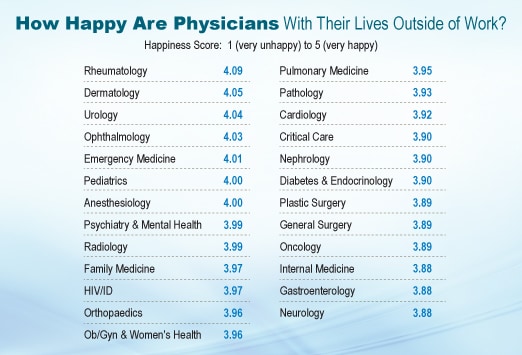
How Happy Are Physicians?
How Happy Are Physicians? According to the 2012 Medscape Physician Lifestyle Report, physicians tend to be fairly happy.

Tuesday, December 27, 2011
Physicians are experiencing burn out
According to this article on American Medical News, "Eighty-seven percent of 2,069 physicians surveyed said they feel moderately or severely stressed or burned out daily."
Physicians are seeking a less hectic schedule, a better work-life balance and greater compensation. Fourteen percent have left their jobs because of stress.
Respondents cited the top causes of stress as the struggling economy (51.6%), health system reform (46.4%) and Centers for Medicare & Medicaid Services policies (41.2%).
The research study was conducted by Physician Wellness Services and Cejka Search.
I know so many physicians who are burning out. They're running out of steam. They're drowning in stress and anxiety. They're looking for alternative employment opportunities. They're switching jobs.
Are you experiencing more stress than before? Are you considering a career change? Maybe you'll be reducing your clinical responsibilities and working part-time. If that's the choice you make, you can find plenty of other opportunities to fill the rest of your time.
Before you consider leaving clinical medicine for a non-clinical career, speak with several people about this important decision. Find other physicians who have made this type of transition. You may be risking long-term job security if you leave the bedside. You may also find yourself really missing the privilege of helping individual patients on a regular basis. It's very difficult (and in some cases, nearly impossible) to go back to clinical medicine once you've left it for several years.
Physicians are seeking a less hectic schedule, a better work-life balance and greater compensation. Fourteen percent have left their jobs because of stress.
Respondents cited the top causes of stress as the struggling economy (51.6%), health system reform (46.4%) and Centers for Medicare & Medicaid Services policies (41.2%).
The research study was conducted by Physician Wellness Services and Cejka Search.
I know so many physicians who are burning out. They're running out of steam. They're drowning in stress and anxiety. They're looking for alternative employment opportunities. They're switching jobs.
Are you experiencing more stress than before? Are you considering a career change? Maybe you'll be reducing your clinical responsibilities and working part-time. If that's the choice you make, you can find plenty of other opportunities to fill the rest of your time.
Before you consider leaving clinical medicine for a non-clinical career, speak with several people about this important decision. Find other physicians who have made this type of transition. You may be risking long-term job security if you leave the bedside. You may also find yourself really missing the privilege of helping individual patients on a regular basis. It's very difficult (and in some cases, nearly impossible) to go back to clinical medicine once you've left it for several years.
Thursday, December 1, 2011
Cancer surgeons' distress and well-being
There are two recent articles in the Ann Surg Oncol titled, "Cancer surgeons' distress and well-being." Some interesting findings regarding career-related stress, coping mechanisms, and work-life balance.
Cancer surgeons' distress and well-being, I: the tension between a culture of productivity and the need for self-care.
Among the 72 surgeons who responded (response rate of 73%), we found that 42% of surgeons reported burnout and 27% psychiatric levels of distress, while 30% used alcohol and 13% used sleep medications as a possible means to cope. Only one third of surgeons reported high quality of life across physical, emotional, spiritual, and intellectual domains.
Cancer surgeons' distress and well-being, II: modifiable factors and the potential for organizational interventions.
Among the 72 surgeons who responded (response rate of 73%), surgeons identified high stress from medical lawsuits, pressure to succeed in research, financial worries, negative attitudes to gender, and ability to cope with patients' suffering and death. Workplace features requiring greatest change were the reimbursement system, administrative support, and schedule. Work-life balance and relationship issues with spouse or partner caused high stress. Strongest correlations with distress were a desire to change communication with patients and the tension between the time devoted to work versus time available to be with family. Surgeons' preferences for interventions favored a fitness program, nutrition consultation, and increased socialization with colleagues, with less interest in interventions conventionally used to address psychological distress.
Cancer surgeons' distress and well-being, I: the tension between a culture of productivity and the need for self-care.
Among the 72 surgeons who responded (response rate of 73%), we found that 42% of surgeons reported burnout and 27% psychiatric levels of distress, while 30% used alcohol and 13% used sleep medications as a possible means to cope. Only one third of surgeons reported high quality of life across physical, emotional, spiritual, and intellectual domains.
Cancer surgeons' distress and well-being, II: modifiable factors and the potential for organizational interventions.
Among the 72 surgeons who responded (response rate of 73%), surgeons identified high stress from medical lawsuits, pressure to succeed in research, financial worries, negative attitudes to gender, and ability to cope with patients' suffering and death. Workplace features requiring greatest change were the reimbursement system, administrative support, and schedule. Work-life balance and relationship issues with spouse or partner caused high stress. Strongest correlations with distress were a desire to change communication with patients and the tension between the time devoted to work versus time available to be with family. Surgeons' preferences for interventions favored a fitness program, nutrition consultation, and increased socialization with colleagues, with less interest in interventions conventionally used to address psychological distress.
Tuesday, November 29, 2011
How does your salary affect your overall job happiness?

How does your salary affect your overall job happiness? If you feel underpaid, that's one thing. If you feel that your salary is a "fair" salary for the type of work you do, then how much happier would you be if your salary went up? How much higher would it need to go up in order for you to feel a sense of greater happiness?
Friday, November 18, 2011
Get Ready for Work-Related Travel in the Business World of Medicine
 I'm writing this in the airplane (thanks to GoGo in-flight Internet) and I'm on my way home. This year, I've had a number of different work-related trips that have taken me to New Orleans, Boston, Baltimore, Phoenix, Palo Alto, Chicago, Washington DC, New York City, Dallas, Orlando, San Francisco, and San Diego. This year was a heavy travel year where I averaged 1-2 trips per month. Most of the time, I was gone for 2-3 nights, but I had an occasional trip where I was gone for a week. Some of those trips were speaking engagements and others were business meetings and conferences.
In the business world, executives travel all the time. There are some people who travel a few times each week. Other people may have 2-3 trips per month. Some folks are gone for 2-3 weeks at a time, especially if they're doing any international travel. During my travels, I run into people who have flown over a million miles and most have elite status on major airlines.
Wednesday, October 5, 2011
Diversify your skill set and improve your work/life balance as a doctor
 Author: Michelle Mudge-Riley, DO, MHA
Is it ever possible to have some sort of work/life balance as a doctor? Many seem to believe it’s a fantasy in part because of the culture of medicine but also in part because we don’t have any training or good examples on how to create some sort of work life balance for ourselves.
One way to help create a work/life balance could be to diversify your skill set. It could be as easy as learning more about healthcare IT and then helping with implementation of your organization’s EHR system. There are many low cost and easy ways like this to diversify yourself. Doing this as a seasoned doctor (and even as a resident) may go a long way in helping to mitigate or reduce feelings of stress and burnout. In fact, a recent JAMA study reported that quality of life and satisfaction with work/life balance was highest among residents who reported moonlighting, or working at a second job outside their regular residency training.
Thursday, September 15, 2011
Quality of life, debt, and burnout among doctors-in-training (residency)
A recent JAMA article titled, "Quality of Life, Burnout, Educational Debt, and Medical Knowledge Among Internal Medicine Residents," concludes:
In this national study of internal medicine residents, suboptimal QOL and symptoms of burnout were common. Symptoms of burnout were associated with higher debt and were less frequent among international medical graduates. Low QOL, emotional exhaustion, and educational debt were associated with lower IM-ITE scores (Internal Medicine In-Training Examination (IM-ITE) scores).Here's what the researchers found:
- Quality of life was rated “as bad as it can be” or “somewhat bad” by 2402 of 16 187 responding residents (14.8%).
- Overall burnout and high levels of emotional exhaustion and depersonalization were reported by 8343 of 16 192 (51.5%), 7394 of 16 154 (45.8%), and 4541 of 15 737 (28.9%) responding residents, respectively.
- In multivariable models, burnout was less common among international medical graduates than among US medical graduates (45.1% vs 58.7%; odds ratio, 0.70 [99% CI, 0.63-0.77]; P < .001). Greater educational debt was associated with the presence of at least 1 symptom of burnout (61.5% vs 43.7%; odds ratio, 1.72 [99% CI, 1.49-1.99]; P < .001 for debt >$200 000 relative to no debt).
- Residents reporting QOL “as bad as it can be” and emotional exhaustion symptoms daily had mean IM-ITE scores 2.7 points (99% CI, 1.2-4.3; P < .001) and 4.2 points (99% CI, 2.5-5.9; P < .001) lower than those with QOL “as good as it can be” and no emotional exhaustion symptoms, respectively.
- Residents reporting debt greater than $200 000 had mean IM-ITE scores 5.0 points (99% CI, 4.4-5.6; P < .001) lower than those with no debt. These differences were similar in magnitude to the 4.1-point (99% CI, 3.9-4.3) and 2.6-point (99% CI, 2.4-2.8) mean differences associated with progressing from first to second and second to third years of training, respectively.
So, what does this suggest? For one thing, residency is grueling and many people burn out or feel that life is terrible. Does this change once physicians complete their residency and enter the busy working world of high-volume patients and stressful working conditions? For some, their outlook improves because their salary has significantly gone up. For others, they battle with greater stress and anxiety because they now have more responsibilities to shoulder as an attending. They no longer have that backup or safety net they used to have during residency training.
Monday, September 5, 2011
Happy Labor Day!

The first big Labor Day in the United States was observed on September 5, 1882, by the Central Labor Union of New York. It was first proposed by Peter J. McGuire of the American Federation of Labor in May 1882.
I hope you're having a blessed time with your friends/family this Labor Day weekend. I had a wonderful time with my wife and kids and we enjoyed the beach, good food, and lots of ice cream! Now, we're back getting ready for a busy fall. We'll be closing our swimming pool and saying good bye to those hot summer days!
Every Labor Day, I'm reminded that I need to re-evaluate how I am balancing work and my personal life. How is your work/life balance? Is your career consuming you? Do you feel trapped or enslaved by work? I hope you'll find a way to escape into a career that is both satisfying and freeing.
Tuesday, March 1, 2011
Moms who pursue non-clinical careers to balance work and life
My wife is a family physician who works roughly 25 hours each week. She gets a day off each week and she gets to spend a significant amount of time at home during her half-days. She's never in the hospital since her practice is 100% outpatient. When she's on call, she practically never gets called after 10 pm. Now, how many physicians have that type of schedule?
Many moms who are also full-time physicians find themselves frustrated by their desire to spend more time at home. Depending on your medical or surgical specialty, you may have a hard time finding part-time opportunities. Those in family medicine, pediatrics, and internal medicine may find some part-time employment jobs. Those in emergency medicine can simply work shifts. But for many other women physicians, they may be limited to full-time clinical employment. So, does it make sense to pursue a non-clinical career to have a better work/life balance? For some, the answer may be "yes."
Many moms who are also full-time physicians find themselves frustrated by their desire to spend more time at home. Depending on your medical or surgical specialty, you may have a hard time finding part-time opportunities. Those in family medicine, pediatrics, and internal medicine may find some part-time employment jobs. Those in emergency medicine can simply work shifts. But for many other women physicians, they may be limited to full-time clinical employment. So, does it make sense to pursue a non-clinical career to have a better work/life balance? For some, the answer may be "yes."
Wednesday, October 27, 2010
How are you doing with time management?

I've made a commitment to be more deliberate and intentional with my "to do" list. I will prioritize my tasks and focus more attention on the time management matrix (from Stephen Covey’s book “First Things First”).
Friday, October 15, 2010
Are you ready to make a career change in 2011?
Many of you may be thinking about a career change. Are you ready to make the transition in 2011? The new year is literally right around the corner and it may be a perfect time for you to explore a part-time or full-time non-clinical career.
As the new year approaches, I've been thinking about ways to improve my work/life balance. Like many of you, I have a full-time job and a family. I also blog and that can often feel like an ongoing moonlighting gig.
Don't forget about our key services:
I hope you'll find the information you're looking for here on NonClinicalJobs.com. I've added an enhanced search box on the upper right section of the page. Use the search box to find something specific.
As the new year approaches, I've been thinking about ways to improve my work/life balance. Like many of you, I have a full-time job and a family. I also blog and that can often feel like an ongoing moonlighting gig.
Don't forget about our key services:
I hope you'll find the information you're looking for here on NonClinicalJobs.com. I've added an enhanced search box on the upper right section of the page. Use the search box to find something specific.
Thursday, September 9, 2010
Physician burnout: what's the solution?

We know that some physicians are leaving clinical practice to pursue other careers. Others are looking for less strenuous work models such as cash or concierge practices. Is this the right solution? Are these physicians finding better work/life balance after making these types of transitions?
I think the solution needs to start in the medical schools. Students need to be educated about the importance of work/life balance and they also need to learn how to creatively develop practice models that will allow them to reach an appropriate balance. Our health care system also needs to be changed so that physicians are being adequately reimbursed for their services.
For those who do choose to leave clinical medicine, they need to know how to find the right opportunities. If you're a surgeon and you want to pursue a non-clinical career, do you know what you could do with your education and training? What if you're a radiologist or a pathologist? If you're considering a career transition, you may want to work with a career coach who can guide you through that process. Click here to learn about the career coaching services we offer on NonClinicalJobs.com.
Monday, August 2, 2010
Title vs. Salary: Which is More Important to You?
In the corporate world, which is more important: your job title, or your salary?
Your job title should reflect your roles and responsibilities within the organization. Some people may make a lot of money, but they may not enjoy the work they're doing. As a result, they may prefer a different job within the same company, even if that means a reduction in salary. Different job titles may be more appealing, even if they don't signify a movement "up" the corporate ladder.
Some people who are currently looking for new job opportunities are looking specifically for jobs where they will have a different title. A job change may seem like a good time to pursue a promotion. Why not go after a new job if you can also move up the corporate ladder?
The issue of salary is fascinating topic because so many people have presumptions and assumptions when it comes to salary. Most doctors make a relatively "high" salary. When you look across the board of different medical specialties, you'll find that doctors make anywhere from $80,000 to over $500,000. That's quite a range, isn't it? It surprises many people when I tell them that there are many physicians who are willing to accept a 20% or even a 40% reduction in salary if they can achieve a better work/life balance. Some physicians are willing to earn much less if they can achieve career satisfaction. The reality is that many physicians are overworked (even after residency) and they simply burn out. They want other options. Therefore, salary drops on the priority scale as other factors rise to the top.
So, how about you? What's more important to you?
Your job title should reflect your roles and responsibilities within the organization. Some people may make a lot of money, but they may not enjoy the work they're doing. As a result, they may prefer a different job within the same company, even if that means a reduction in salary. Different job titles may be more appealing, even if they don't signify a movement "up" the corporate ladder.
Some people who are currently looking for new job opportunities are looking specifically for jobs where they will have a different title. A job change may seem like a good time to pursue a promotion. Why not go after a new job if you can also move up the corporate ladder?
The issue of salary is fascinating topic because so many people have presumptions and assumptions when it comes to salary. Most doctors make a relatively "high" salary. When you look across the board of different medical specialties, you'll find that doctors make anywhere from $80,000 to over $500,000. That's quite a range, isn't it? It surprises many people when I tell them that there are many physicians who are willing to accept a 20% or even a 40% reduction in salary if they can achieve a better work/life balance. Some physicians are willing to earn much less if they can achieve career satisfaction. The reality is that many physicians are overworked (even after residency) and they simply burn out. They want other options. Therefore, salary drops on the priority scale as other factors rise to the top.
So, how about you? What's more important to you?
Tuesday, May 4, 2010
Time management: a review for physicians
 Where do physicians go when they need help with time management? Most physicians are so busy that they probably don't even have time to think about time management.
There's an old review article published in 1996 titled, "Time management: a review for physicians." Here's the abstract:
This article reviews the basic concepts and techniques of time management as they relate to a medical lifestyle. Essential tools are described to help the physician reassess and sharpen skills for handling intensifying demands and constraints of juggling patient care, research, teaching, and family responsibilities. The historical background and principles of time management for three popular "best selling" techniques are critiqued. In addition, a fourth technique, or model, of time management is introduced for physician use.J Natl Med Assoc. 1996 September; 88(9): 581–587. (you can view the entire article here)
Even though this article is over 10 years old, the same principles still apply today. In fact, I'd argue that life has reached a new level busyness. We live in the digital era of continuous information exchange. We're bombarded by information through the Internet, television, mobile phones, short message service (SMS) texting, and social media. How do physicians balance work and life when they're so busy?
Many physicians end up burning out because they are so busy with their clinical responsibilities. Some even choose to leave clinical medicine because they reach a point where they no longer enjoy have the responsibilities of a physician.
If you're thinking about leaving clinical medicine because you feel like you're burning out, perhaps you can find a better practice setting where you'll find a better work/life balance. Maybe you need a change in practice setting instead of a new career. Perhaps you can regain some of the lost passion behind clinical medicine. For others, they simply need to switch careers. They need an alternative option. If that's you, then I hope you'll find some useful resources here on this site.
Wednesday, April 7, 2010
Struggling to make decisions about business school
 Many of you know that I've been thinking about business school for many years. The biggest struggle I'm having right now is that I'm getting more involved with side ventures and they're eating up my time. I'd like to spend more time with my family, but I'm simply doing too many things (blogging, consulting, etc.). So, how does business school fit into this mix?
- Am I willing to give up 2 weekends each month to pursue an executive MBA?
- A part-time MBA would give me much more flexibility, but I may not gain the same level of networking opportunities.
- Should I spend more time with these side ventures? That would delay my plans for business school.
I'm hoping that after I attend the MD/MBA conference in Boston this weekend, I'll get some more clarity about this issue.
Subscribe to:
Posts (Atom)